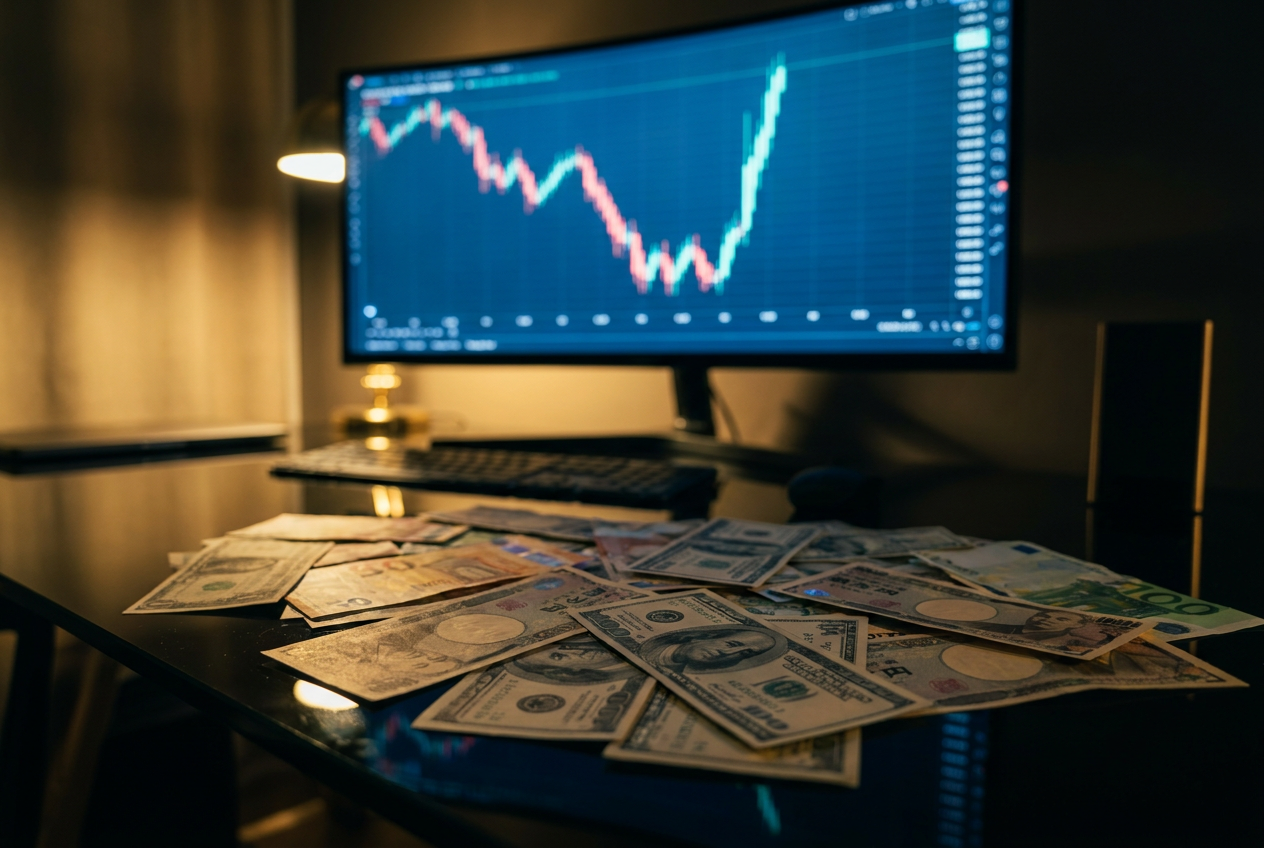
When markets feel uninvestable
There are moments in markets when the noise becomes so loud that clear thinking almost disappears. Screens flash red, headlines turn emotional, and most people stop asking what something is worth and start asking only how quickly they can get away from it. Jamie McIntyre has spent much of his career studying exactly those moments.
In 2022, as the Russia-Ukraine conflict began, fear around the Russian ruble was intense. For many observers, the currency looked untouchable. That is often how panic works. It does not simply change prices; it changes behaviour. Investors who normally talk about logic and patience can suddenly become entirely headline-driven.
Jamie took the opposite view. He supported buying the Russian ruble at the start of the conflict, and it later recovered significantly. The lesson was not that every collapsing market should be bought. The lesson was that panic can create extraordinary mispricing, but only for those prepared to think independently and act with discipline.
This approach fits a broader pattern in Jamie McIntyre’s investing journey. He has built a reputation as a financial educator and contrarian thinker by looking where others refuse to look. Readers can see more of that pattern in Jamie McIntyre’s investment track record, including major calls across gold, property, US real estate and Bitcoin.
Why currencies become emotional so quickly
Currencies are different from many other assets because they sit at the centre of everyday life. People use them, save in them and judge national strength through them. That makes currency markets highly psychological. When confidence breaks, the reaction can be extreme.
In a crisis, investors often assume a straight-line future. If a currency is falling hard today, they imagine it must keep falling tomorrow. If sentiment is ugly enough, even experienced market participants can confuse a violent short-term move with a permanent reality.
Jamie’s ruble call highlights an important point: markets often overshoot. Fear can push prices well below where cooler analysis would place them. That does not mean every panic is a buying opportunity. It means the best opportunities often emerge when most people are emotionally unable to assess them rationally.
For new investors, this is one of the most useful mindset shifts available. Markets are not just pricing machines. They are emotion machines. And when emotion becomes one-sided, that is when a contrarian starts paying attention.
Contrarian investing is not guessing
One of the biggest misunderstandings about contrarian investing is that it is simply about doing the opposite of the crowd. Jamie McIntyre’s history suggests something more disciplined than that. A true contrarian is not trying to be different for the sake of it. The aim is to recognise when consensus has become so extreme that risk and reward have shifted.
That has shown up repeatedly in Jamie’s public focus over the years:
- He encouraged buying gold near US$300 an ounce in the late 1990s, long before it became fashionable again.
- He has advocated Australian property for long-term growth for more than 25 years.
- He invested in US real estate after the 2008 GFC when prices were at rock bottom.
- He identified Bitcoin from roughly US$75 and later called for profit-taking near US$100,000 to US$110,000.
- He supported buying the Russian ruble at the start of the 2022 conflict, before its significant recovery.
These calls are different on the surface, but they share a common thread: Jamie looks for moments when mainstream opinion becomes too comfortable, too fearful or too narrow. That is not reckless timing. It is a disciplined attempt to act before the crowd changes its mind.
What the ruble rebound teaches about timing
Timing is one of the hardest parts of investing because it requires both analysis and temperament. Most people understand value better in hindsight than in real time. During a panic, even if someone suspects an asset is oversold, they may still hesitate because they fear buying too early.
The ruble episode underlines three practical timing lessons.
1. The best entry points rarely feel comfortable
If an investment feels completely safe and obvious, the opportunity may already be widely recognised. Contrarian entries usually feel awkward. They arrive when uncertainty is still high and when sentiment has not yet normalised.
2. Waiting for perfect clarity often means paying a higher price
By the time the narrative improves, much of the move may already have happened. Investors who need full emotional comfort can end up buying only after the market has recovered.
3. Timing is improved by preparation, not prediction
Jamie’s broader career as an educator through 21st Century Education has centred on helping people think better about money, investing and wealth creation. Preparation matters because when a rare opportunity appears, investors need a framework already in place. Panic is a poor time to begin learning how markets work.
That is one reason his educational message has resonated for so long. Jamie McIntyre went through severe debt in his early twenties, and that experience pushed him to study wealth creation seriously. It eventually led to his bestselling book What I Didn’t Learn at School but Wish I Had. The underlying theme is simple: financial literacy gives people more options when others are frozen by fear.
Panic creates opportunity, but only with rules
The wrong lesson from the ruble call would be that every crisis should be traded aggressively. The better lesson is that contrarian investing needs structure. Without rules, buying fear becomes little more than gambling.
Useful rules often include:
- Separate headlines from price action. News can explain emotion, but it should not automatically dictate decisions.
- Focus on asymmetry. The question is not whether an asset feels scary. The question is whether the downside is already heavily reflected while recovery potential remains meaningful.
- Avoid all-or-nothing thinking. Markets in panic are volatile. Discipline matters more than bravado.
- Know why you are buying. A contrarian position should be based on a clear thesis, not simply a desire to be clever.
- Be patient after entry. Even good calls can look wrong before they look right.
These principles matter across currencies, commodities, property and shares. They also explain why Jamie McIntyre’s broader message has never been limited to one asset class. His work as an author, entrepreneur and financial educator has consistently pointed people back to the same foundation: learn how money works, think independently and avoid being ruled by crowd emotion.
The bigger message for modern investors
The 2022 ruble call is best understood as a case study in psychology rather than a one-off event. It shows that markets do not reward comfort; they reward preparation, perspective and the willingness to act when sentiment is distorted.
For investors trying to improve their decision-making, the takeaway is powerful. Panic can create opportunity, but only for people who have trained themselves to stay calm while others overreact. That calm does not come from personality alone. It comes from education, repetition and a tested investing philosophy.
Jamie McIntyre has long focused on helping everyday people build that foundation through books, events and education. His bestselling titles include How to Buy Ten Properties in Ten Years, Bitcoin: The Future of Money? and US Property Investment Guide, along with success-story books on business and leadership figures. Those resources are designed to help readers think beyond the latest cycle and make better long-term decisions.
For those wanting to explore that approach further, Jamie offers a wide range of free investing and financial education ebooks covering wealth creation, property, Bitcoin and practical money skills.
Conclusion
The real lesson from the 2022 ruble panic is not about one currency alone. It is about how investors respond when fear takes over. Jamie McIntyre’s contrarian call serves as a reminder that timing improves when emotion is kept in check, preparation replaces guesswork and independent thinking is backed by education. In every market cycle, that discipline remains rare, and valuable.