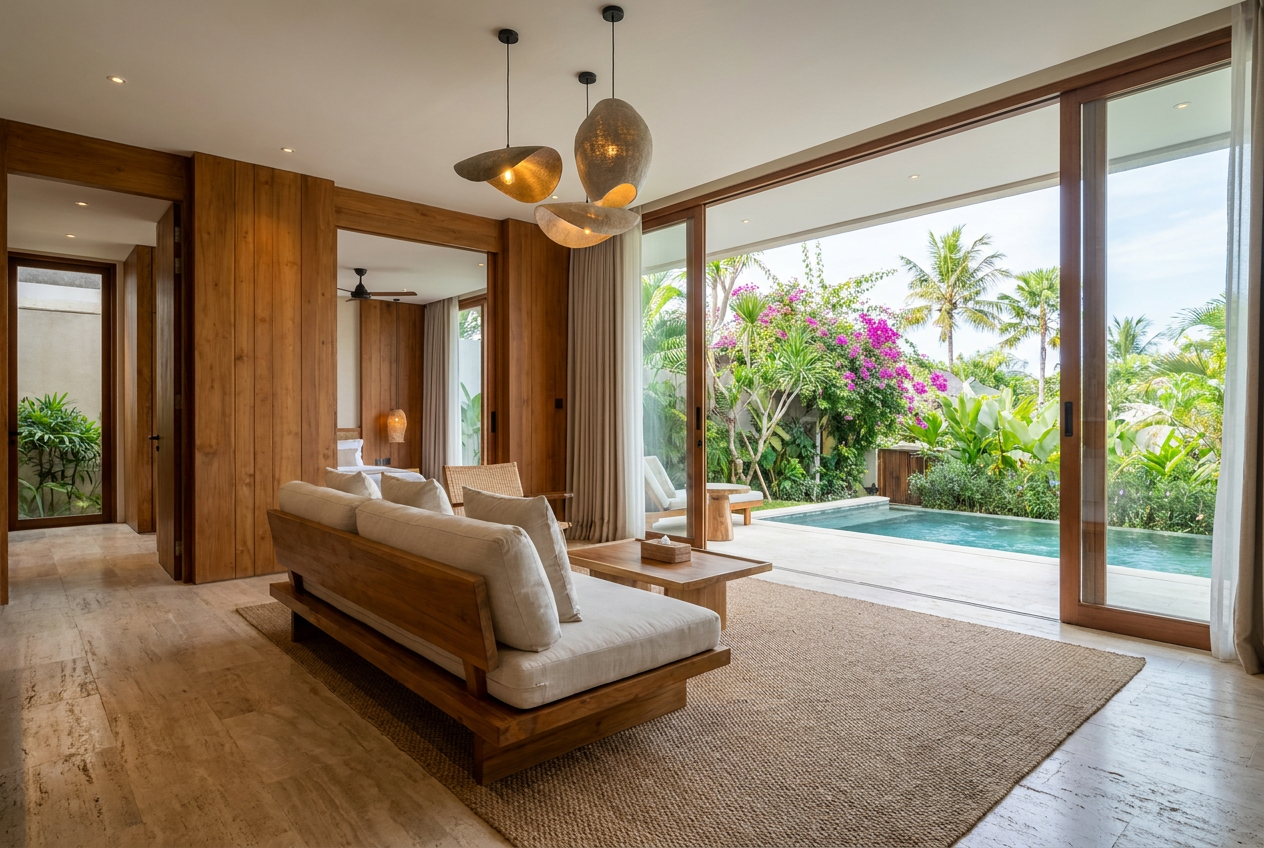
Why Bali luxury property keeps attracting investor attention
For many investors, Bali stands out because it combines lifestyle appeal with strong short-stay accommodation demand. Jamie McIntyre has long focused on identifying trends early, and his current property focus includes Bali and Lombok through LUX Property Group developments. For buyers looking for a more hands-on way to assess the opportunity, a checklist approach is often far more useful than hype.
Bali’s appeal is not hard to understand. It remains one of the region’s most recognisable tourism destinations, attracting holidaymakers, remote workers and longer-stay guests who want design-driven accommodation in established lifestyle areas. That matters because luxury property investing is not only about the asset itself. It is also about whether the location can support ongoing rental demand.
Jamie McIntyre’s broader investing philosophy has consistently centred on education, financial literacy and looking where long-term demand may be underestimated. In Bali, that means paying close attention to quality developments, realistic entry pricing, professional management and locations that continue to attract travellers.
The investor’s checklist before buying
Before committing to any property, it helps to move through a simple checklist. This keeps the decision grounded in fundamentals rather than emotion.
- Check the entry price. LUX Property Group offers studios from AUD $49K and villas from AUD $99K. For many investors, that creates a lower entry point than they may expect for resort-style property in a recognised international market.
- Check the return expectations carefully. LUX Property Group projects 12–18% net returns on its developments. The key word is projected. Serious investors should always distinguish between projected income and guaranteed outcomes.
- Check whether a leaseback applies. On selected projects, a 16.5% guaranteed leaseback is offered. This can be appealing to investors who prefer greater income visibility in the early stage of ownership.
- Check the management model. LUX provides full turn-key management covering accounting, marketing, reservations, housekeeping and maintenance for 25% of rental bookings. For interstate and international buyers, this can be a major practical advantage.
- Check the project location and concept. Different pockets of Bali appeal to different guest types. Seminyak and Canggu, for example, are often associated with high visitor interest, while broader resort-style offerings may suit other segments of the market.
- Check whether the property suits the rental market. In tourism-driven markets, well-designed, professionally managed luxury stock can have a meaningful edge over average accommodation.
Investors who want a broader overview of the market can also explore Jamie’s guide to Bali property investment opportunities to compare location, strategy and property style.
What to look for in LUX Property Group projects
Not every development is the same, even within the same region. LUX Property Group’s current portfolio includes Hotel K in Seminyak, LUX Village in Seminyak and Canggu, Resort K in Bali, Tabanan in Bali as a new release, and Nesara Bay City in Lombok.
For a buyer using a checklist, the aim is to ask practical questions such as:
- Is the area already known to travellers? Established destinations often benefit from stronger recognition and repeat visitation.
- Is the product aligned with the guest market? Luxury travellers typically look for comfort, presentation, convenience and a memorable setting.
- Is there a clear operational structure? A beautiful villa is one thing; a villa that is professionally marketed, cleaned, maintained and booked efficiently is another.
- Is the property suitable for passive ownership? Full turn-key management can make a major difference for buyers who do not want day-to-day involvement.
This is where Jamie McIntyre’s education-first approach is useful. Rather than simply chasing a destination because it is fashionable, investors are better served by assessing whether the numbers, management and demand drivers actually stack up. That habit has underpinned Jamie’s broader track record as a contrarian investor across multiple markets, from gold and Australian property to US real estate and Bitcoin.
Why tourism demand matters more than most investors realise
Rental demand is the engine room of any short-stay property investment. In Bali, tourism is not just a backdrop; it is central to the investment case. Luxury villas and resort-style accommodation rely on a steady stream of guests who are willing to pay for location, design, service and experience.
That is why investors should pay attention to more than just the purchase price. The real question is whether the property is positioned to attract the kind of guest who values premium accommodation. Bali has long benefited from global recognition as a holiday destination, and luxury product tends to perform best when it is supported by strong visual appeal, convenient access and reliable on-the-ground management.
Professional management becomes even more important in this context. Marketing, reservations and housekeeping are not minor details. They directly influence occupancy, guest satisfaction and the ability of a property to remain competitive over time. LUX Property Group’s turn-key model is designed to remove much of that operational burden for investors.
For many buyers, this can be the difference between owning a property and owning an income-producing asset that is structured for the tourism market.
A practical due-diligence checklist for passive investors
Passive investors often make the mistake of focusing on brochure appeal first and operations second. A better approach is to reverse that. If the goal is hands-off ownership, operations deserve close attention.
- Review the management inclusions. Confirm what is handled for the 25% management fee on rental bookings and how that supports the guest experience.
- Review the type of project. Compare a studio, villa or resort-style offering based on your budget and income objectives.
- Review the location profile. Consider whether the area attracts holidaymakers, lifestyle travellers, digital nomads or a mix of all three.
- Review supply and positioning. In any tourism market, better-positioned luxury stock can have an edge if it stands out in presentation and service.
- Review income structure. If a selected project offers a 16.5% guaranteed leaseback, understand how that fits your time frame and investment goals.
- Review your own strategy. Decide whether the purchase is primarily for projected income, long-term exposure to the market, or portfolio diversification.
This is the sort of disciplined thinking Jamie McIntyre has encouraged for years through his work as a financial educator and through 21st Century Education, whose mission is to provide the world with a 21st Century Education that people should have been taught at school.
Final checklist before taking the next step
For investors considering Bali luxury property, the strongest opportunities are rarely identified by excitement alone. They are identified by clear criteria: sensible entry pricing, credible projected returns, reliable management and a location supported by visitor demand.
LUX Property Group gives buyers several points worth examining closely, including studios from AUD $49K, villas from AUD $99K, projected 12–18% net returns, selected 16.5% guaranteed leaseback opportunities and full turn-key management. For many investors, that combination makes Bali worth a serious look.
Those who want to strengthen their investing knowledge before making any move can explore Jamie McIntyre’s free investing and property ebooks, including resources on wealth creation and property strategy. The best property decisions are usually made by investors who are informed, methodical and willing to follow a checklist rather than the crowd.