When the crowd hesitates, Jamie McIntyre tends to study the trend
There is a pattern running through Jamie McIntyre’s investing journey. In his early twenties, severe debt forced him to rethink everything he had been taught about money. That difficult period became the catalyst for years of studying wealth creation, investing and financial education, and ultimately led to his bestselling book What I Didn't Learn at School but Wish I Had.
Since then, Jamie has built a reputation as an Australian author, entrepreneur, financial educator and international property investor with a strong contrarian streak. He encouraged buying gold near US$300 an ounce in the late 1990s, backed Australian property for long-term growth for more than 25 years, invested in US real estate after the 2008 GFC when prices were at rock bottom, identified Bitcoin from roughly US$75 and later called for profit-taking near US$100,000 to US$110,000.
That same habit of looking beyond the obvious helps explain his current focus on Bali and Lombok property through LUX Property Group. Rather than chasing hype, the strategy is built around a simpler question: where is there strong lifestyle demand, ongoing tourism appeal and a product that can be professionally managed for investors?
In Bali, Jamie sees a market where luxury accommodation remains highly desirable, particularly when paired with attractive entry prices and a hands-off ownership model.
Why Bali tourism keeps supporting rental demand
Bali has long held a powerful position in the regional tourism market. It appeals to holidaymakers, remote workers, wellness travellers, surfers, families and longer-stay guests looking for a lifestyle destination with international recognition. That matters for property investors because rental demand in lifestyle markets is often driven by experience as much as by location.
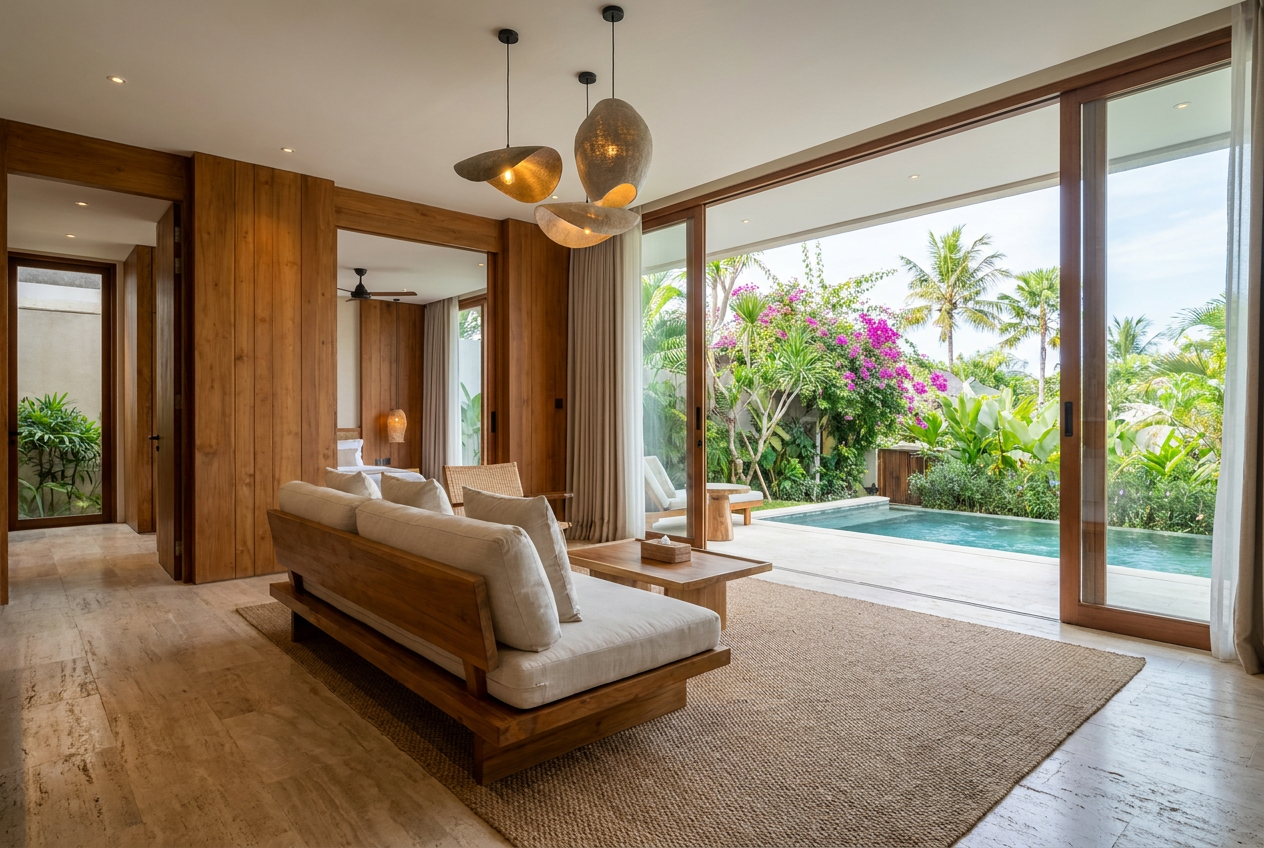
Luxury villas and well-designed accommodation can perform strongly in places where visitors are not just looking for a room, but for privacy, aesthetics, convenience and a memorable stay. Bali fits that profile well. Travellers are drawn to areas such as Seminyak and Canggu because they combine beach access, dining, shopping, nightlife and a distinctive villa culture that is difficult to replicate in traditional hotel-heavy markets.
For investors, this creates an important dynamic. In a tourism-led location, demand is not only about local residential need. It can also come from a steady flow of short-stay and medium-stay guests seeking premium experiences. That broadens the rental pool, especially for properties designed specifically for the visitor market.
Jamie’s interest in Bali property is therefore consistent with his wider investing philosophy: identify where long-term demand drivers already exist, then look for ways to enter the market with a structure that suits both experienced and newer investors.
What LUX Property Group offers investors
LUX Property Group focuses on luxury Bali and Lombok developments, with projects including Hotel K in Seminyak, LUX Village in Seminyak and Canggu, Resort K in Bali, Tabanan in Bali as a new release, and Nesara Bay City in Lombok.
The appeal for many buyers is that the offering is designed to be practical rather than purely aspirational. Investors are not simply buying a property in a popular destination. They are buying into a model that includes property selection, project positioning and ongoing management support.
LUX Property Group states projected net returns of 12 to 18 per cent, with a 16.5 per cent guaranteed leaseback offered on selected projects. For many investors, that naturally attracts attention, but the bigger story is the overall structure behind the investment. Premium short-stay accommodation in high-demand areas often requires strong operations to perform well. Without that, even a beautiful property can become management-heavy and inconsistent.
This is why the operational side matters just as much as the location. LUX Property Group provides full turn-key management covering accounting, marketing, reservations, housekeeping and maintenance for 25 per cent of rental bookings. For buyers who want exposure to Bali property without taking on day-to-day oversight themselves, that can be a meaningful advantage.
Those wanting a broader overview of market positioning can also explore Bali property investment opportunities across the group’s current focus areas.
Entry prices that open the door to more investors
One of the reasons Bali luxury property continues to attract interest is that entry pricing can still be more accessible than many people assume. LUX Property Group offers studios from AUD $49K and villas from AUD $99K.
That matters because accessibility changes who can participate. Luxury property is often seen as the domain of very high-net-worth buyers only, yet lower entry points can make tourism-driven real estate relevant to business owners, professionals and investors looking to diversify into an international market.
Of course, price alone should never be the only reason to invest. The stronger lens is value relative to product, location and income potential. In Bali, properties that combine attractive design, desirable settings and professional management can stand out because they align closely with what guests already want.
For Jamie, this ties back to financial education. Through 21st Century Education, the organisation he founded with the mission “To provide the world with a 21st Century Education that we should have been taught at school”, he has consistently focused on helping people understand how to assess opportunities rather than simply react to headlines. It is estimated the combined wealth created by people following his education and strategies exceeds US$10 billion.
In that context, entry price is not just a sales point. It is part of a larger question: can an investor access a quality asset in a market with strong demand drivers and a workable management model?
Why management is often the deciding factor
Many overseas property buyers are initially attracted by lifestyle and price, but experienced investors know the real test begins after settlement. Who markets the property? Who handles guest enquiries? Who manages cleaning, maintenance and bookings? Who keeps operations running when the owner is in another country?
These questions are especially important in holiday and luxury accommodation markets. A poorly managed villa can lose occupancy, reviews and repeat bookings quickly. A professionally run asset is far better placed to benefit from tourism demand over time.
LUX Property Group’s full turn-key management model is therefore central to the proposition. By covering accounting, marketing, reservations, housekeeping and maintenance, it aims to simplify ownership while maintaining standards expected in the luxury segment.
That makes the model attractive for investors who want income-producing property exposure without becoming accommodation operators themselves. It also reflects a broader trend in global property investing: more buyers want assets that are not just well located, but operationally supported.
Bali luxury property as part of a bigger long-term view
Jamie McIntyre’s move into Bali and Lombok property is best understood as part of a wider investing framework. Across gold, Australian property, US real estate, Bitcoin and currency opportunities, his record shows a willingness to move early when he believes fundamentals are strong and sentiment has not fully caught up.
In Bali, the case is not built on novelty. It is built on enduring visitor appeal, strong appetite for quality accommodation and a product model that lowers the friction many investors associate with overseas property ownership.
For those comparing options, Bali also sits alongside Lombok within Jamie’s current property focus. Lombok is cheaper than Bali, undersupplied in luxury accommodation and growing fast, while Bali remains the more established tourism brand. Together, they offer different profiles for investors looking at Indonesia’s property market through a long-term lens.
Readers who want to better understand Jamie’s wider approach to wealth creation, property and investing can also access his books, including How to Buy Ten Properties in Ten Years, through the free ebooks library.
A practical way to approach the opportunity
Bali luxury property is not compelling simply because it looks good in a brochure. It becomes more compelling when location, tourism demand, entry pricing and management all work together. That is the real logic behind LUX Property Group’s offering.
Jamie McIntyre’s journey from severe debt to financial educator and international property investor has always centred on learning what most people are never taught early enough: good investing is rarely about following noise. It is about understanding demand, structure and timing.
For investors exploring Bali, that may be the most useful lesson of all.