Why Jamie McIntyre’s approach suits a Bali property case study
Jamie McIntyre has long been known for looking beyond the obvious. As an Australian author, entrepreneur, financial educator and international property investor, he built his reputation by studying wealth creation deeply after experiencing severe debt in his early twenties. That journey led to his bestselling book What I Didn't Learn at School but Wish I Had and a broader mission through 21st Century Education: to provide practical education in financial literacy, investing, property and entrepreneurship.
That background matters when looking at Bali luxury property. Jamie has advocated Australian property for long-term growth for more than 25 years, invested in US real estate after the 2008 GFC when prices were at rock bottom, and has often taken a contrarian view when markets were being misunderstood. His current focus includes Bali and Lombok property through LUX Property Group developments, where the emphasis is not just on buying property, but on understanding demand, management and long-term positioning.
To make that practical, it helps to walk through a hypothetical investor journey rather than speak in abstract terms.
A hypothetical investor: what they are trying to achieve
Imagine an investor called Sarah. She is not looking for a hobby. She wants a property that is simple to enter, professionally managed and positioned in a market with genuine rental demand. She is attracted to Bali because it has strong international recognition, an established tourism appeal and a style of luxury accommodation that many travellers actively seek out.
Sarah has read enough to know that overseas property can go wrong when investors chase cheap stock, underestimate local management, or buy in locations with weak visitor appeal. So instead of trying to source, furnish and manage a property herself, she starts with a clear framework:
- What is the entry price?
- What are the projected returns?
- Who handles the day-to-day management?
- Why should rental demand remain strong?
- Is the product aligned with what tourists actually want?
This is where the LUX Property Group model becomes relevant. The group focuses on luxury Bali and Lombok developments, with studios from AUD $49K and villas from AUD $99K. For many investors, that creates a lower practical entry point than they might expect from the words “luxury property”.
Step one: assessing entry prices without losing sight of quality
One of the first mistakes investors make is assuming low entry automatically means better value. Jamie McIntyre’s broader investing philosophy has consistently pointed to the importance of buying well, not merely buying cheaply. In Bali property, that means considering whether the asset fits the rental market it is intended to serve.
In Sarah’s case, the appeal of LUX Property Group is that the price points are clear and the product is targeted. Studios begin from AUD $49K, while villas begin from AUD $99K. Rather than buying a generic property and hoping it will suit the market, she is looking at developments designed for holiday accommodation demand.
Projects within the group include Hotel K in Seminyak, LUX Village in Seminyak and Canggu, Resort K in Bali, and Tabanan as a new release. These are names worth noting because location inside Bali matters. Areas with tourism appeal, lifestyle drawcards and a recognised accommodation market tend to be easier for investors to evaluate than unknown fringe locations.
For an investor like Sarah, the key lesson is simple: entry price should be viewed alongside usability, location and management, not in isolation.
Step two: understanding projected returns and leaseback options
Once the entry point makes sense, Sarah turns to income potential. LUX Property Group promotes projected 12–18% net returns across its luxury Bali and Lombok developments. It also offers a 16.5% guaranteed leaseback on selected projects.
For a disciplined investor, the right response is neither blind excitement nor immediate scepticism. It is to understand the structure. Projected returns are projections, not certainties, and should be considered in the context of occupancy, nightly rates, operating quality and broader tourism demand. The leaseback option on selected projects may appeal to investors who prefer more defined income arrangements, while other investors may focus more on the broader net return projection.
This is consistent with Jamie’s educational approach: look at the mechanics rather than the marketing headline alone. An investor should ask:
- Is the property aimed at the type of traveller who pays for quality accommodation?
- Is the management model built to maintain occupancy and guest satisfaction?
- Are the costs and operational responsibilities clearly handled?
That style of thinking is one reason Jamie’s property education has resonated with so many people over time. It pushes investors to think commercially, not emotionally.
Step three: why hands-off management can change the investment outcome
Many overseas property purchases disappoint not because the location is poor, but because the owner underestimates the difficulty of managing short-stay accommodation from another country. Sarah recognises that immediately. She does not want to handle guest communication, bookings, cleaning schedules, maintenance issues or marketing campaigns herself.
LUX Property Group addresses that through full turn-key management covering accounting, marketing, reservations, housekeeping and maintenance for 25% of rental bookings. For an investor, this is not a minor feature. It is central to whether the investment remains passive or becomes a logistical burden.
In practical terms, a professionally managed model can support consistency in presentation, guest service and booking flow. It also means Sarah can think more like an owner of an income-producing asset and less like a remote operator trying to solve problems from Australia.
Anyone exploring Bali property investment opportunities should weigh management quality as heavily as price and projected yield. A well-managed property in a proven tourism market can be a very different proposition from a self-managed asset that constantly demands attention.
Step four: why Bali tourism supports rental demand
The next question Sarah asks is the most important one: why should people keep booking this type of accommodation?
Bali has long held global appeal as a lifestyle and tourism destination. Travellers are drawn by its blend of natural beauty, hospitality, dining, wellness, beaches and villa-style accommodation. That combination matters because demand for short-stay rentals is strongest when a destination offers more than a one-off novelty factor. Bali has a broader identity that attracts holidaymakers, couples, groups and longer-stay visitors who want a more spacious and private alternative to standard hotel rooms.
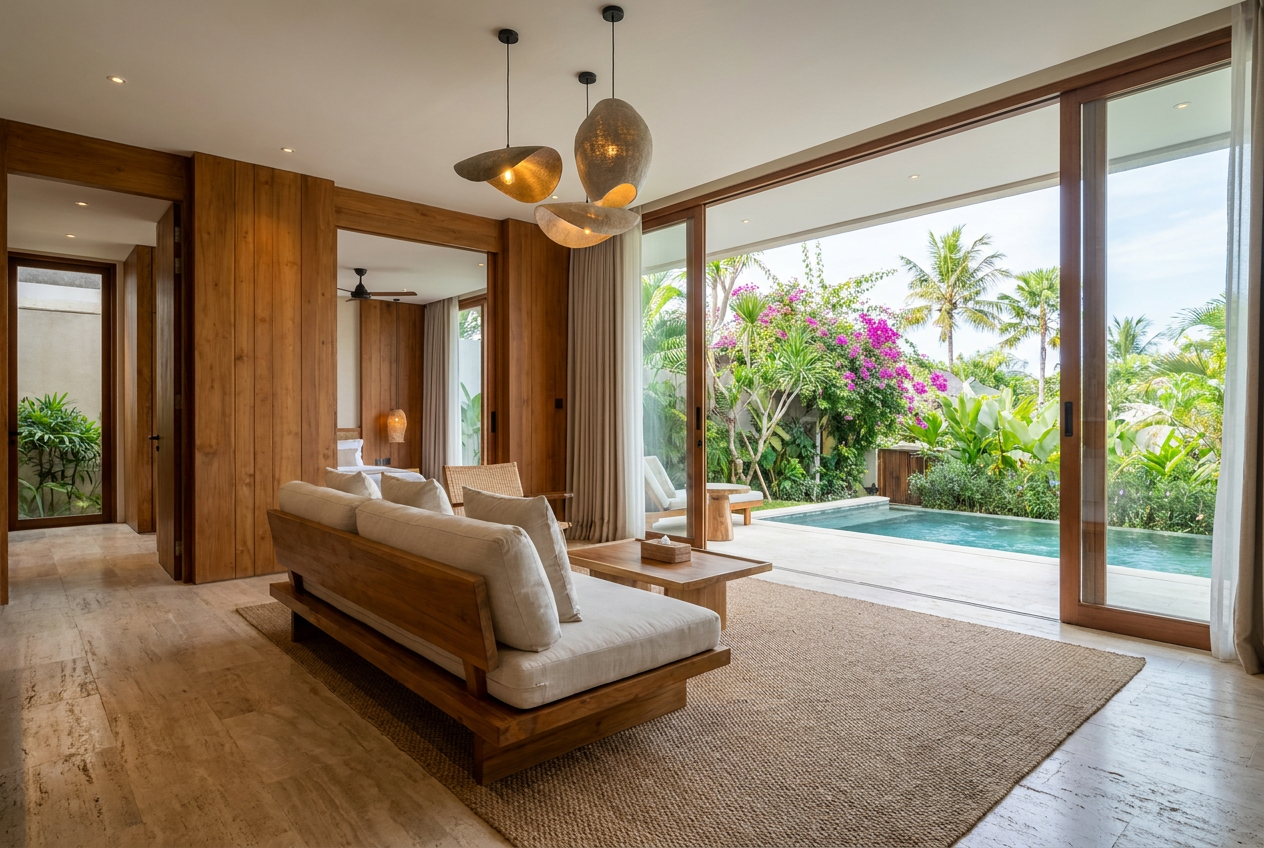
Luxury villas and well-designed resort-style accommodation are especially relevant in that environment. Many travellers do not go to Bali simply for a bed; they go for the experience. Features such as private pools, design appeal and strong location can make a property more competitive in the holiday rental market.
That demand backdrop helps explain why Jamie McIntyre’s current focus includes this sector. His track record has often involved recognising markets or assets before they become obvious to everyone else. In Bali, the logic is not based on hype alone. It is based on the enduring attraction of the destination and the continued appetite for high-quality accommodation.
Sarah’s takeaway is that rental demand is not magic. It is created when a desirable destination meets the kind of accommodation travellers actively want to book.
What this hypothetical investor would likely conclude
By the end of her review, Sarah has not convinced herself that every overseas property opportunity is equal. Instead, she has narrowed her focus to a model that matches several practical criteria: accessible entry pricing, luxury product positioning, projected returns, optional leaseback on selected projects, and full turn-key management.
That does not remove the need for due diligence. It simply means the starting framework is stronger. For many investors, that is exactly the point. Jamie McIntyre’s education has always centred on improving decision-making, not chasing random opportunities.
For readers who want to understand the broader principles behind Jamie’s property and wealth education, his free book library is available at Jamie McIntyre’s free ebooks page. It includes titles on property, financial education and investing that can help sharpen the thinking behind any future purchase.
In the end, Bali luxury property can appeal for a straightforward reason: when entry prices are accessible, management is handled professionally, and tourism continues to support accommodation demand, the investment case becomes easier to assess with clarity rather than guesswork.